Prairie City
The OutlawsPrairie City is the remote Montana town where Del Delaney’s ordinary life as a ranch hand is abruptly overturned. Set close to the Canadian line, it offers little entertainment beyond what residents arrange for themselves; the monthly dance is therefore both a social occasion and the setting for the accusation that sends Del into exile. The town’s small scale makes its local relationships especially consequential: a dance, a walk home, and an arrest at a family doorstep become the beginnings of a reputation that travels well beyond Prairie City.
Setting and Community
Prairie City lies near the Canadian line, in a place Del describes as isolated enough that residents had to devise their own diversions. The first-Saturday dance was a major occasion in the town’s social calendar. It drew Del away from his usual routine at Wineglass, the ranch where he had worked for ten years, about ten miles from town. He rode in alone, intending to attend the dance and return to the ranch the next day.
Del’s family life also connects the town to the surrounding ranch country. His mother taught the primary grades at the Prairie City school and cooked at Wineglass during the summers. She did not care for dances, so Del stopped at her house to clean up before going out. He expected to sleep late and ride back to work on Sunday afternoon. Instead, the house became the place where the town’s law reached him: the following morning, Sid Blackwell arrived with a cocked gun and arrested him on a rape charge.
The Dance and the Accusation
The dance brings Del into contact with Ruby Prentiss, a woman widely discussed in Prairie City. Del recognizes her attractiveness and the attention she attracts, but he does not treat the rumors about her as reliable. After the dance, he walks her home. She invites him inside, then asks him to go to the bedroom. Del feels trapped by the situation and leaves rather than accept the invitation. His departure is decisive in retrospect: the next day, Blackwell charges him with rape.
Blackwell is not a distant official arriving from outside the community. He is a deputy sheriff, Ruby’s steady boyfriend, and, as the book’s account later explains, the son of the local judge. Those ties give the accusation a sharply local dimension. Del’s account presents the charge as false and stresses that rape is the last crime he would commit. Yet the immediate power to arrest him belongs to Blackwell, who appears at Del’s mother’s home and points his weapon at him while announcing the charge. Prairie City’s familiar social setting thus becomes the starting point of Del’s separation from ordinary life.
Flight from Prairie City
After his arrest, Del escapes rather than remain in custody. Before leaving, he takes money his mother had saved in a sugar bowl for a heating stove, leaves her a note promising to repay it, and takes his late father’s Winchester from the front room. His own rifle is at Wineglass, but he does not go there. These choices mark the speed and cost of his departure: he leaves both his ranch routine and his mother’s household behind, taking only what he can quickly use to get away.
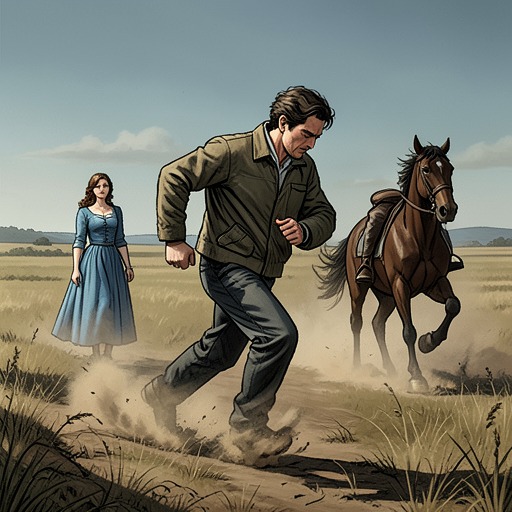
Del leaves through the barn, saddles his buckskin horse, Jim Dandy, and rides north as if heading toward Wineglass. Once out of sight of town, he turns southwest and gallops away. The change of direction makes his departure a deliberate evasion rather than a return to the life he had planned for the weekend. He continues generally westward, crosses the state line into Wyoming, avoids larger towns and county seats, and sometimes lives on game or buys supplies at country stores. Prairie City remains the point from which this wandering begins, even when Del is far beyond its reach.
Reputation and Narrative Significance
The charge does not stay local. Del begins the story already known to many Montana sheriffs because reward notices bearing his name have been posted in their offices. Later, he recognizes that Blackwell has circulated the information about his being wanted so effectively that a sheriff far from Montana can identify him as a fugitive. The notice gives Prairie City’s accusation a continuing afterlife: a claim made in a small town becomes a threat that can confront Del wherever he uses his real name.
That spread also clarifies the difference between the charge and the life it produces. Del’s flight takes him across a state line and into encounters with other wanted men, but it does not erase the accusation or restore the future he expected before the dance. The town’s isolation is therefore double-edged. It limits entertainment and makes the dance unusually important, while its close relationships—especially those linking Ruby, Blackwell, and the local judge—help determine Del’s fate. Prairie City is not merely the place he leaves; it is the origin of the legal identity he carries with him.